Research
Associate
New
Appointment Associate
Professor,
Adjunct
Professor,
Knapping videos now available as indexed dvds- see below
Thank you for coming to this
site. I apologize that the page has been missing for over a year. I am now working to get it restored and
updated. I know there are missing
links and will keep fixing them as I can.
Thanks for your patience.

This is a photo of me
with a large flint nodule from adjacent to the Les Maitreaux Solutrean site in
My position is Associate Professor in
the Department of Archaeology
at the University of Exeter. I am teaching
various courses including lithic technology and analysis, archaeological
materials and have been appointed Director of the Experimental
Archaeology Masters Programme. It is unique and extremely well
designed. It is a one-year (full time or two years part-time) Masters in
Experimental Archaeology. Although students have a set number of
courses, labs, etc., there is ample opportunity to explore their own
interests. For more information check out the department web
page.
I am also continuing my various research
projects and plan to get some of the results added to this page, especially an
interactive, image-driven report on Stix and Leaves Pueblo. I have now
completed my field research with my colleague Sandra Olsen in northern
My continued work with Dennis Stanford on
the issue of
I am continuing to work closely with Mike
Collins and the Texas Archaeological Research Lab (TARL) and have recently been
appointed Research Associate. We have had a long association and this is
currently being strengthened. I am writing a book on
The Gault Site was purchased by Dr. Collins and subsequently donated to the Archaeological Conservancy ensuring its long-term conservation. There is also a not-for-profit organization called the Gault School, that is active in support of continued education and research at the Gault Site.
In March/April 2007 I took 4
I am planning to continue to take groups of
In 2003 I organized a group of people to assist with an interesting
lab-based project on the Gault collection, which was a success, but not
in the way we expected. Our groups helped with analysis of a sample of the
Our assigned task was to examine collections of artifacts from various
excavation units and to systematically conjoin broken pieces and refit flaking
sequences. Through refitting, Mike has recently discovered a very curious and
unexpected flaking process with
We started with the collection of blades and blade cores from an area designated Bobcat 15. We laid all of these pieces out on tables and tried fitting every blade to every core blade scar and to every blade scar on the dorsal surfaces of blades (blades to blades). The result was a whopping no refits! We did manage to get a couple broken pieces conjoined and one flake onto a core. This lack of refits was an extreme surprise. Because of the distinctive nature of blades and blade cars, refitting should be relatively straight forward.
We put the blades away and laid out the biface products including all bifaces (broken and intact), finished points, debitage larger than about 2cm, overshot flakes, and channel flakes. Many bifaces exhibited overshot flake scars and channel flake scars and we had lots of overshot flakes and channel flakes. All of these types are distinctive and once again refitting should be fairly straight forward. We found two biface conjoins and two flakes that refit, and that was all. Unbelievable! I must say that I greatly admire the diligence and perseverance of the participants. They did a marvelous job. We also did the same refitting with Bobcat 16 and Bobcat 18, with the same results.
Although we can't say that we found all possible refits, it is clear that if
they exist in these areas, they are extremely rare. The archaeological site
formation process indicates that geological mixing and erosion were minimal and
cannot account for this lack of refitting. Because of this, we have to
completely reassess our interpretation of how the artifacts came to be where
they were found. Mike has been saying for a long time that the Gault Site was
more then just a place occasionally visited by
The process of carefully examining all types of
I also took the opportunity to record technological attributes of 75
While engaged in the technological and refitting studies, we also helped
with recording other attributes of the assemblage, specifically whether or not
flint artifacts were burned. We did this for area Bobcat 18 where a cobble
pavement might represent a
All in all, the project was very rewarding even though it didn't find what
we expected. One might say it was more important because we didn't find what we
expected. How often can a two week analysis produce information that
significantly changes one's entire interpretation of what a site was? Although
Mike has been arguing that the

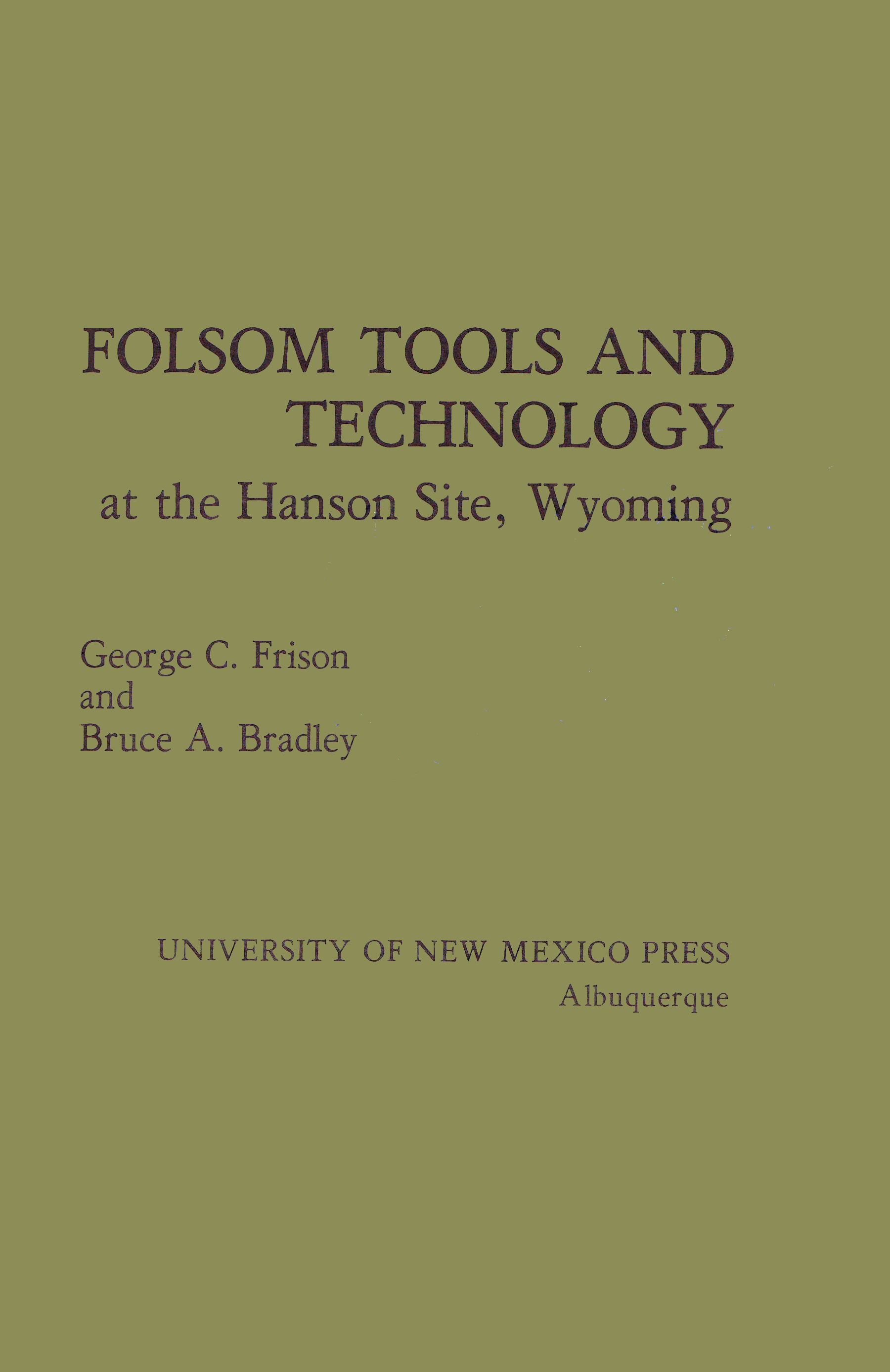
THE FENN CACHE is a lavishly
illustrated book by George Frison and Bruce Bradley discussing and illustrating
this amazing
FLINTKNAPPING by
Dr. Bruce Bradley
Now Available in
"I
watched your video with a couple friends this week. I haven't seen it for a
long time and when I first watched it several years ago it seemed like magic.
I've done a couple of demos lately and have tried to figure out ways to keep
them more interesting during the relatively long thinning and shaping stage
without switching midway through to a prepared piece. That's what really struck
me about your demo -- when you are ready to start making the point you are
already halfway there and the audience was kept interested all the way along.
See his great page Knappers Anonymous
This video is a great addition to any flintknapping library and is being
shown in most beginning archaeology courses in universities and colleges across
Another dvd is now available on
ALSO AVAILABLE

A third
Order them from http://www.petroglyphtrail.com or
call 800-687-5967
SOUTHWESTERN ARCHAEOLOGY
I have been away from my
Southwestern archaeology interests for too long now, but have plans to get back
into it. In the summer of 2005 I spent a couple of weeks in
For early reports see Wallace Ruin, a
Chaco Outlier near
Research into
For some really interesting information on Chaco Culture and Pueblo II visit John Kantner's page .
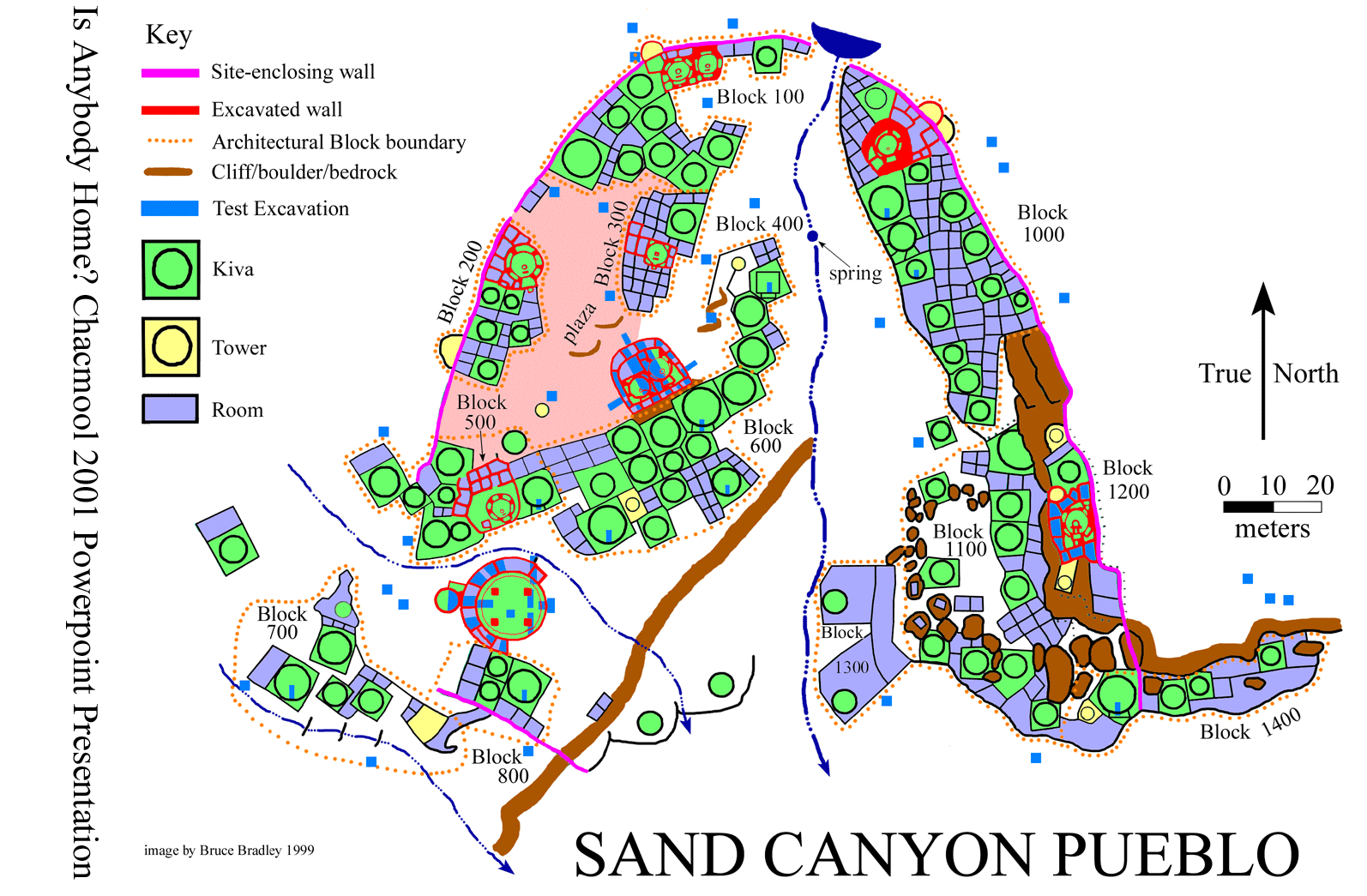
Stix and Leaves Pueblo (5MT11555) in Montezuma County, Colorado is an Early Pueblo II Village where I excavated a roomblock and associated kivas and pithouses. I am working on an interactive web-based report and will post it when finished. In the mean time you can see the results of tree-ring dating for all of the excavations and check out an article on projectile points from the site. It was poublished in Indian Artifact Magazine, Vol. 20, No. 1. ANASAZI PROJECTILE POINTS
There are also color images and text from a published Chips article Vol. 13, #1 2001 Southwest Projectile Points
Along with standard archaeology, I have also done many experimental projects including a replica kiva construction. Check out the many images of the complete process.
One outcome of the experimental kiva is that there are some amazing, accidental, solar alignments. These should serve as cautionary tales for budding archaeo-astronomers who see "significant" alignments everywhere. Check them out!
The kiva has now been unmaintained for 5 years but I have been documenting it as it deteriorates. There are some interesting and unexpected results.
PALEO-AMERICAN ARCHAEOLOGY
SLOAN DALTON
Check out good photos of the points, awls, burins,
and scrapers (made on points) from the Sloan Site, a Dalton Cemetary in NE
Arkansas. These images are posted here to supplement the poor illustrations in
the otherwise excellent book by Dan Morse (Sloan a Paleoindian Dalton Cemetary
in
PEOPLING OF THE
If you are interested in looking at a now outdated
dialog about the origins of people in the
Dennis Stanford (Smithsonian) and I have published
our theory and summarized the supporting data in the scholarly journal World Archaeology in
December 2004, and we are close to submitting the final draft of our
long-awaited book to the
The "Clovis First" and "Beringia
Only" theories have been crumbling for years, but for many of us are now
totally collapsed. There is now overwhelming direct evidence for
pre-Clovis occupation of the American continents, and virtually no direct
evidence that all of these early people must have come through Siberia.
For some examples see:
Click
here for a recent
View an article on
There are many links to this topic and all you
have to do is start searching the internet to see how emotional and engaging
the issue is.
KAZAKH ARCHAEOLOGY
In 1995 I spent two weeks in northern Kazakhstan
on an excavation at the Eneolithic (Copper Age) site of Botai with my colleague
Sandra Olsen, of the Carnegie Museum in Pittsburgh. Her special interest is the
domestication of the horse, and the central Asian steppe is a likely place to
find evidence. It is known that horses were domesticated by the Bronze Age, so
it must have happened earlier. I found many intriguing problems related to this
subject and Sandi and I decided to collaborate on a new research project. We
applied for and obtained a three year grant from the U.S. National Science
Foundation and began field work in the summer of 2000. I will be posting
articles and images here as we finish them. Kazakhstan is a fascinating country
and the people are very friendly. There was an article on our work in DISCOVER
Magazine in the March 2002 issue. Their photographer got some great pictures
this summer of traditional Kazakh horse nomads. The text has some weird bits,
such as Sandi being afraid of horses- this is baloney. Can't control what the
press does. However, the best media story about our work was on the radio-
In the summer of 2001 we found and recorded a
prehistoric flaking stone quarry site, we believe the first to be documented
with quarry pits in
The summer of 2001 was unusually wet and cool in
northern Kazakhstan. Rather then continue excavations at the Eneolithic site of
Krasnyi Yar, we investigated a nearby Neolithic site that we named Zhusahn (the
Kazakh word for sage). I was especially interested in this site because I
wanted to see if there was a significant change in the stone flaking
technology. I was also curious to see if the same stone sources were in use
during these consecutive time periods. Here is a report on our excavations and
analyses at Zhusahn. I have intentionally kept
the illustrations at a relatively high resolution, so those with slow computers
and internet connections, like me, should be patient when viewing the images.
The field season of 2002 took us to another
Eneolithic, Botai Culture site near Kokshetau. Vasilkovka IV turned out to be
an interesting excavation. This year, summer came on a Tuesday. Although the
winter had been quite mild, it didn't seem to want to give way to summer; and
then it reasserted itself after just a short respite.
Never the less, we managed to complete
magnetometer and resistivity surveys, and excavated a pithouse and associated
features. A report on this work is currently in preparation. Stay tuned.
RUSSIAN ARCHAEOLOGY
In the summer of 2003 I was privileged to
participate in another archaeological research project in Russia, Zhokhov. I
was invited by the project director Dr. Vladimir Pitulko and sposor Dr. Edmund
(Ted) Carpenter.. The Zhokhov site is Mesolithic in age (circa 8,500
years old) and is located in one of the farthest north places people ever lived
in the Stone Age. It is on the small island of Zhokhova northeast of the main
group of the New Siberian Islands, off of the north shore of Siberia (Yakutia).
Check out an abstract
of an article by Ted.
In the summer of 2005 I took 13 Exeter archaeology
students to the excavations at Zaraysk (see below) directed by Dr. Hizri
Amirkhanov and Dr. Segey Lev. This is one of my favourite places, digs, and
groups of people and we had an incredible time and learning experience.
The first international conference to be held in
the Russian town of Zaraysk was an interesting experience. I have worked in
Zaraysk three summers and really enjoy it. Twice, I have lead groups of amateur
archaeologists to help with the excavations. Learn about the conference and see
some images of the Eastern Gravettian Conference in
Zaraysk, Russia, 1997
We think that we have old bifacial projectile
points in North America, but they don't hold a candle to some I have studied
from European Russia. Read an article about Streletskayan Points of the
Russian Upper Paleolithic
Here is a brief description of the Russian Upper
Paleolithic site of Kostenki. I
worked at this site for several years and lead a group of amateurs there to
help with the excavations. It is a fantastic place and I hope to return some
day soon. The archaeology is tremendous, the people are great, and the setting
on the Middle Don River is nearly idylic.